


Lesson 1 — The God Who Speaks: Revelation
This opening lesson introduces the breathtaking truth that all theology begins with a speaking God. Rather than leaving humanity to speculate in darkness, the Triune God graciously reveals Himself through creation, Holy Scripture, and ultimately in His Son, Jesus Christ. Students will explore the distinction between general and special revelation, the nature of Scripture as God-breathed, the unfolding pattern of progressive revelation throughout the biblical covenants, and the climactic self-disclosure of God in Christ. Centered in the gospel and grounded in the inerrancy and sufficiency of the Word, this lesson invites believers to hear, trust, and respond to the God who still speaks through His written Word.
_JPG.jpg)
Every generation faces the same profound and unsettling question: Has God spoken? Behind the noise of our age, beneath headlines, opinions, and the restless hum of modern life, lies a deep ache woven into the fabric of every human soul. It is the longing to know whether the God who created the world has made Himself known. Philosophers have reasoned, poets have imagined, and scientists have observed, but none of these human attempts can bridge the chasm between the finite creature and the infinite Creator. Left to ourselves, we could never ascend high enough, think clearly enough, or perceive deeply enough to uncover the mind of God. And yet standing under a silent canopy of stars, something within us still whispers, Is there a Word beyond the silence?
The Christian confession begins with a resounding yes. The God of Abraham, Isaac, and Jacob, the Father of our Lord Jesus Christ, has spoken. He is not a distant deity cloaked in mystery, nor a mute force behind the universe. He is the living God who lovingly reveals Himself so that His creatures may know Him truly, worship Him rightly, and find redemption in His Son. Revelation, therefore, is not the product of human ingenuity but the gracious act of God condescending to disclose Himself to us. Without revelation, theology would be nothing but speculation; with revelation, truth becomes solid ground beneath our feet.
To say that God speaks is to affirm that the Creator is personal, relational, and purposeful. His first speech appears on the opening page of Scripture: “Then God said, ‘Let there be light’” (Genesis 1:3). The cosmos itself was born through divine speech. Creation is not merely matter in motion, it is the result of God’s authoritative voice calling reality into existence. And the same God who spoke light into darkness continues to speak into the world He made. This is the heart of biblical revelation and the foundation of all theology.
In this lesson, we explore the three central modes of God’s revelation: His declaration in creation, His Word inscripturated in Holy Scripture, and His climactic self-disclosure in the incarnate Word, Jesus Christ. Along the way, we will also consider the purpose of revelation, namely, relationship and redemption, and the church’s sacred duty to guard the completed revelation given once for all to the saints. All of this leads us to the life-changing truth that our God is not silent. He is speaking still through His all-sufficient, God-breathed Word.
God Reveals Himself in Creation
The first avenue of God’s revelation is what theologians call general revelation. This revelation is universal, continuous, and accessible to every human being. As the psalmist declares, “The heavens are telling of the glory of God; and their expanse is declaring the work of His hands” (Psalm 19:1). The sky itself preaches a daily sermon. Every sunrise proclaims God’s creativity; every star glimmers with the proclamation of His majesty. You can set aside Scripture, close every theological textbook, and stop your ears from every preacher’s voice, and yet creation itself will not cease to declare that God is God.
Psalm 19 paints this picture vividly. Day after day, creation pours forth speech; night after night, it reveals knowledge. No language barrier can obstruct this witness, for creation’s message is nonverbal yet universally understood. Likewise, the apostle Paul confirms creation’s revelatory power when he writes that God’s eternal power and divine nature “have been clearly seen, being understood through what has been made, so that they are without excuse” (Romans 1:20). Creation testifies to God’s existence, power, wisdom, and glory. It tells us that we are not accidents. It tells us that beauty has a source, order has a designer, and life itself has a giver.
Yet even with all its grandeur, creation’s revelation is limited. The stars may announce God’s greatness, but they cannot proclaim His grace. The flowing river may stir awe, but it cannot assure forgiveness. The mountain may display strength, but it cannot reveal salvation. Creation is a magnificent introduction, but it is not the full story. To see the panorama of God’s redemptive plan, we need a clearer Word, a Word not written in the sky but written in Scripture.
God Reveals Himself in Scripture
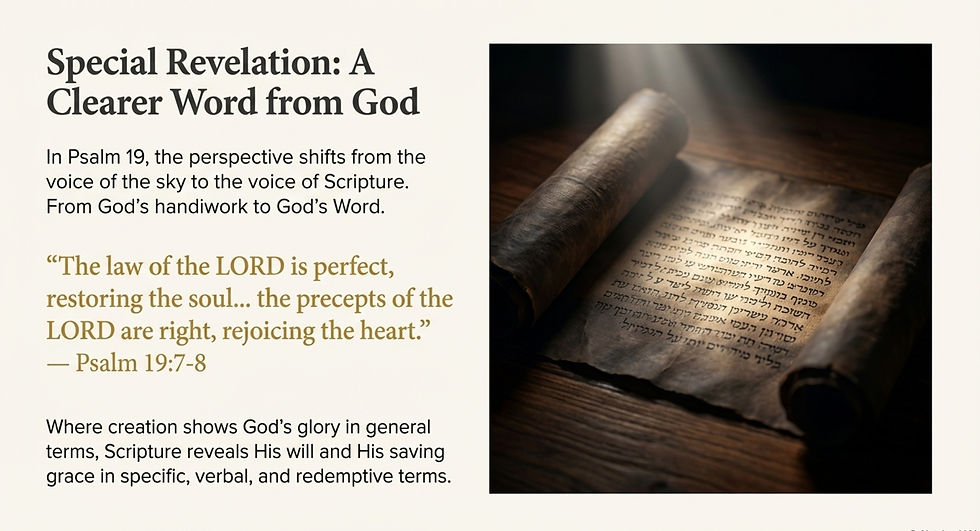
If general revelation declares that God is, special revelation declares who God is. Nowhere is this clearer than in Psalm 19, where the psalmist transitions seamlessly from the voice of the heavens to the voice of Holy Scripture. The language shifts from creation’s universal proclamation to the rich, covenantal terminology of God’s written Word: “The law of the LORD is perfect, restoring the soul; the testimony of the LORD is sure, making wise the simple” (Psalm 19:7).
Scripture provides what creation cannot: the specific, verbal, redemptive revelation of God’s character, will, and saving purposes. Paul states it unmistakably: “All Scripture is inspired by God” (2 Timothy 3:16). The Greek term theopneustos means “God-breathed.” This is not metaphorical inspiration; it is divine exhalation. Scripture is not merely a record of religious experience or human reflection about God, it is God Himself speaking in written form. Through the agency of human authors, God delivered His authoritative Word, perfect in every detail, complete in its truthfulness, and entirely trustworthy.
The attributes of Scripture listed in Psalm 19 form a breathtaking mosaic of divine revelation. The law of the LORD is perfect, complete, without flaw, sufficient for every spiritual need. It restores the soul, reviving the heart weighed down by sin and sorrow. The testimony of the LORD is sure, steady, reliable, unwavering amid the shifting currents of culture. It makes wise the simple, granting God’s people insight into the mysteries of life and the path of righteousness. The precepts of the LORD are right, straight, morally sound, aligned with the very character of God. They rejoice the heart, kindling holy delight in the believer. The commandment of the LORD is pure, clear, unclouded by error or deceit, enlightening the eyes. The judgments of the LORD are true—they stand firm, righteous altogether.
Scripture alone gives us the knowledge necessary for salvation. Paul tells Timothy that the sacred writings “are able to give you the wisdom that leads to salvation through faith which is in Christ Jesus” (2 Timothy 3:15). No mountain vista, no ocean wave, no whisper of conscience can announce the gospel. Creation may stir awe, but the Scriptures reveal Christ. General revelation condemns; special revelation redeems.
Moreover, Scripture demonstrates what theologians call progressive revelation. God did not reveal everything at once but disclosed His saving purposes gradually across the unfolding story of Scripture. From the first gospel promise in Genesis 3:15 to the covenant with Abraham, from the law given at Sinai to the promises spoken by the prophets, God was unveiling His redemptive plan piece by piece. Like dawn breaking upon the horizon, the light grew brighter until the fullness of revelation arrived in the appearing of Jesus Christ.
God Reveals Himself in His Son
If creation is the introductory word and Scripture the written word, then Christ is the final Word. The author of Hebrews proclaims this truth with unmatched clarity: “God, after He spoke long ago to the fathers in the prophets in many portions and in many ways, in these last days has spoken to us in His Son” (Hebrews 1:1–2). Christ is not merely another messenger in a long line of prophets; He is the climactic revelation toward which all previous revelation pointed.
John declares, “And the Word became flesh, and dwelt among us” (John 1:14). The eternal Word through whom all things were created entered His creation as Redeemer. When Jesus speaks, it is God’s voice in human words. When Jesus acts, it is God’s character embodied in human form. When Jesus touches the leper, it is divine compassion made visible. When He calms the sea, it is divine authority exercised through a human voice. When He dies on the cross, it is divine mercy poured out for sinners.
Christ is the perfect exegesis of God: “He has explained Him” (John 1:18). He reveals the Father with clarity and fullness that creation could never display and Scripture itself anticipated but could not embody. In Jesus Christ, God reveals Himself not only in speech but in flesh. The incarnation is revelation in its most intimate and accessible form, God with us, God among us, God for us.
This means that Christianity is not fundamentally a philosophy or an ideology. It is a relationship with the living Lord who is Himself the revelation of God. To know Christ is to know the Father; to hear Christ is to hear God; to follow Christ is to walk in the light of divine truth. All revelation, creation, Scripture, prophecy, covenant, finds its fulfillment and culmination in Him.
The Purpose of Revelation: Relationship and Redemption
Why does God reveal Himself? Not to satisfy curiosity or indulge the speculative impulses of theologians. Revelation exists for relationship and redemption. God speaks because He desires to be known, loved, and worshiped. He reveals Himself so that sinners may be drawn into fellowship with Him through the saving work of His Son.
John captures this purpose beautifully: “These have been written so that you may believe that Jesus is the Christ, the Son of God; and that believing you may have life in His name” (John 20:31). Scripture is not merely information; it is invitation. It calls us to trust, repent, believe, and rejoice in the gospel. Revelation moves us from ignorance to faith, from rebellion to repentance, from death to life.
This truth rescues theology from becoming cold or detached. Doctrine divorced from devotion is malformed. Truth severed from worship is incomplete. Revelation is given not merely to shape our minds but to transform our hearts. To read the Bible is to enter into communion with the living God who speaks through every page and meets His people in His Word.
The Protection of Revelation: Guarding the Church
Because God has spoken fully and finally in His Son and preserved His Word in the Scriptures, the church is called to guard this revelation with vigilance. The canon of Scripture is closed. Divine revelation is complete. The Holy Spirit continues to illumine the text but does not reveal new truths beyond what is written. Jude instructs believers to contend earnestly for “the faith which was once for all handed down to the saints” (Jude 3).
This means that any claim to new revelation, new doctrine, or new authoritative speech from God must be tested, and if it contradicts Scripture, it must be rejected. A Word-centered church is a protected church. Where Scripture is open, read, believed, and proclaimed, the voice of Christ is heard. Where Scripture is marginalized or silenced, the church becomes vulnerable to deception, manipulation, and error.
The Response to Revelation: Hearing and Obeying
Revelation is never neutral. Whenever God speaks, we must respond. Scripture repeatedly calls God’s people to listen with reverence and obedience: “Today if you hear His voice, do not harden your hearts” (Hebrews 3:15). The proper response to God’s revelation is faith, repentance, worship, and obedience.
For the unbeliever, the call is clear: the God who spoke the universe into existence now speaks grace through His Son. The gospel summons sinners to turn from sin and trust in the crucified and risen Christ. For the believer, God’s revelation calls for daily submission and delight. The Scriptures must shape our worship, direct our families, govern our choices, and inform our hopes. God’s Word is not merely to be studied; it is to be cherished, meditated upon, and obeyed.
Christ: The Center of All Revelation
If one image can summarize this entire lesson, it is this: the Word and the Word made flesh. Christ is present in every mode of revelation. In creation, He is the divine Word through whom all things were made. In Scripture, He is the promised Redeemer, foreshadowed in every sacrifice, anticipated in every covenant, and foretold in every prophecy. In the incarnation, He is the Word made flesh, the radiance of God’s glory, the exact representation of His nature.
At the cross, revelation reaches its peak. The God who once said, “Let there be light,” now speaks forgiveness through the blood of His Son. The One who brought order from chaos in Genesis now brings salvation from sin through Christ. Everything God reveals moves toward Christ and flows from Christ. He is the Alpha and the Omega of divine revelation.
Conclusion: The God Who Still Speaks
We live in a world saturated with noise: alerts, headlines, messages, chatter. Yet above the clamor is a voice older than creation, stronger than chaos, and gentler than the morning breeze: the voice of the God who speaks. He has spoken in creation, declaring His glory. He has spoken in Scripture, revealing His truth. He has spoken in His Son, unveiling His heart. The real question is not whether God has spoken but whether we are listening.
To the unbeliever, the call is urgent: the God who created you invites you to be recreated in Christ. To the believer, the invitation is continual: let the Word of God dwell richly within you. Let Scripture be the first voice you hear in the morning and the last you hear at night. Let it steady your mind, warm your heart, convict your conscience, and shape your life. When you open the Bible, the Author meets you there.
Our God is not silent. He has spoken and His Word brings life. May we be a people who hear, trust, obey, and rejoice in the God who speaks.

_JPG.jpg)
_JPG.jpg)
_JPG.jpg)
_JPG.jpg)