_edited.jpg)

What Is Prayer, Really? Rediscovering Communion with God
- Joshua Nichols
- May 5
- 6 min read

Prayer is among the most familiar practices in the Christian life, and yet, paradoxically, it is often among the most misunderstood. For many, prayer becomes little more than a religious reflex: something we do before meals, in moments of crisis, or when we feel especially burdened. It is treated as a kind of spiritual transaction, words offered upward in the hope that God might respond favorably.
But Scripture presents something far deeper, far richer, and far more transformative.
At its heart, prayer is not merely asking, it is communion.
Jesus Himself reframes our understanding when He says:
“If you abide in Me, and My words abide in you, ask whatever you wish, and it will be done for you” (John 15:7, NASB).
Notice carefully the order: abiding precedes asking. Prayer is not the starting point of the relationship, it is the fruit of it. It flows out of union with Christ, out of a life that is already rooted and grounded in Him.
To pray, then, is to participate in something profoundly relational. It is the living fellowship between the redeemed soul and the living God.
This truth alone reshapes everything.
The author of Hebrews exhorts believers with these words:
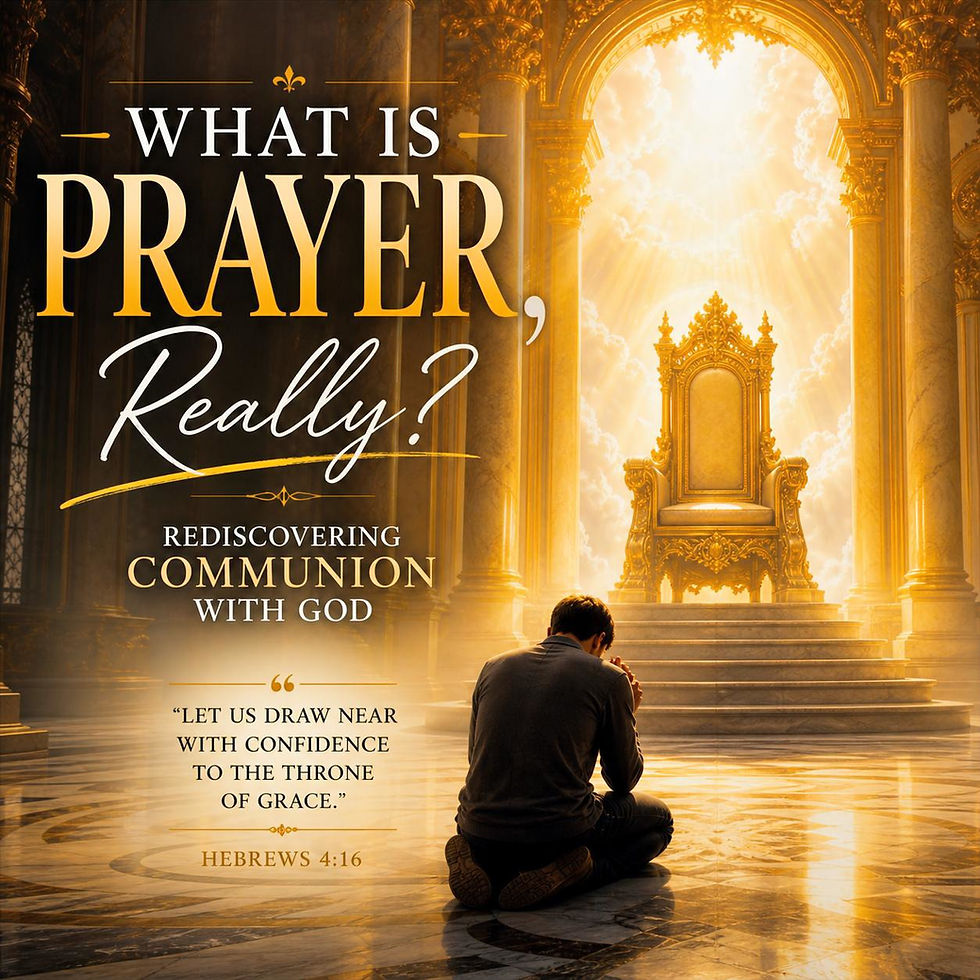
“Therefore let us draw near with confidence to the throne of grace, so that we may receive mercy and find grace to help in time of need” (Hebrews 4:16).
This is not poetic exaggeration. It is theological reality. Through the finished work of Jesus Christ, our great High Priest who has passed through the heavens, we are granted access into the very presence of God.
When you pray, you are not speaking into emptiness. You are not rehearsing thoughts into silence. You are not hoping your words reach some distant deity.
You are, by grace, entering the throne room of heaven.
And here is where we must pause and examine ourselves honestly.
If we truly believed this, if this reality gripped our hearts with clarity and conviction, would we struggle so greatly to pray?
If we genuinely believed that each time we bowed our heads or lifted our thoughts heavenward, we were stepping into the presence of our heavenly Father… if we believed that He is there, attentive, sovereign, yet tender toward His children… if we were convinced that He hears every word, every whisper, every trembling plea, every burst of gratitude, every confused question, even the groanings we cannot articulate, would prayer feel like a burden?
Would it feel like an obligation we must force ourselves to fulfill?
Or would it become the very place we long to be?
The truth is, our difficulty with prayer is rarely due to a lack of time. We find time for what we value. Rather, our struggle is often rooted in a diminished vision of God. We forget who He is, and we forget what has been granted to us in Christ.
Jesus teaches us to begin prayer with these words: “Our Father who is in heaven” (Matthew 6:9, NASB). In this simple address, we are given a theological treasure of immense depth.
He is our Father, this speaks of intimacy, relationship, and covenantal love. Through adoption in Christ, we are not strangers or outsiders. We are sons and daughters. We are welcomed, not tolerated.
Yet He is also in heaven, this reminds us of His transcendence, His holiness, His sovereign rule over all things. He is not like us. He is exalted above all creation, enthroned in majesty.
True prayer holds these together: nearness and reverence, intimacy and awe.
If we lean too far toward intimacy without reverence, prayer becomes casual, even flippant. If we lean too far toward reverence without intimacy, prayer becomes distant, fearful, and restrained. But when both are held in their proper place, prayer becomes what it was always meant to be: the child drawing near to the Father with both confidence and humility.
Consider the Psalms, the inspired prayer book of God’s people. There we find not polished religious language, but raw, unfiltered honesty. David cries out in anguish, wrestles with doubt, expresses frustration, confesses sin, and erupts in praise. He does not sanitize his emotions before bringing them to God.
Why?
Because he knows he is heard.
“Evening and morning and at noon, I will complain and murmur, and He will hear my voice” (Psalm 55:17).
Prayer, then, is not performance. It is not about saying the right words in the right order with the right tone. It is about bringing your real self before the real God.
It is the weary soul finding rest. It is the anxious heart casting its burdens. It is the sinner clinging to mercy. It is the believer abiding in Christ.
And here we must address a subtle but important misconception: prayer is not primarily about changing God’s mind. God is not uncertain, nor is He reactive in the way we are. “For I, the LORD, do not change” (Malachi 3:6, NASB). His purposes are fixed, His will is perfect, and His knowledge is exhaustive.
Yet prayer is still profoundly meaningful. Why?
Because God has ordained not only the ends, but also the means. Prayer is one of the means by which He accomplishes His purposes in the world and in us. In prayer, we are drawn into alignment with His will. Our desires are reshaped. Our affections are redirected. Our trust is deepened.
Prayer does not merely change circumstances, it changes us.
As we commune with God, our hearts begin to echo His. What we once clung to tightly, we begin to release. What we once ignored, we begin to cherish. What once troubled us deeply begins to rest under the sovereignty of God.
This is why prayer is so essential, not as a duty to check off, but as a lifeline to God Himself.
And yet, even knowing these truths, many still struggle.
Perhaps you feel distracted when you pray. Perhaps your mind wanders. Perhaps your words feel empty or repetitive. Perhaps you feel unworthy, or distant, or uncertain whether God truly hears you.
Hear this clearly: your access to God is not grounded in your performance, but in Christ’s perfection.
You do not enter the throne room because you prayed well yesterday. You do not gain God’s ear because your words are eloquent. You do not maintain your standing by emotional intensity.
You come because Christ has made a way.
“Therefore, brothers, since we have confidence to enter the holy place by the blood of Jesus” (Hebrews 10:19).
It is His righteousness that grants you access. It is His intercession that sustains you. It is His Spirit who even helps you pray, as Romans 8:26 reminds us, that in our weakness, when we do not know how to pray as we should, the Spirit intercedes for us.
What grace is this?
Even our imperfect prayers are carried by a perfect Mediator.
So if prayer feels difficult, do not begin by condemning yourself. Begin by lifting your eyes.
Recover a clearer vision of God. See Him as He has revealed Himself in Scripture: holy, sovereign, unchanging, and yet merciful, compassionate, and abounding in steadfast love. See Him as your Father, who delights in the prayers of His children.
And remember this: He is not waiting for you to impress Him. He is inviting you to come.
Come with your doubts. Come with your fears. Come with your joys and your gratitude. Come with your anger and your confusion.
He already knows, and yet He still calls you to speak.
If we truly believed that we were entering the throne room of heaven each time we prayed, if we truly believed that our heavenly Father was there, attentive and welcoming, hearing every word, every cry, every joy, every concern, our struggle with prayer would begin to fade.
Not because life becomes easier.Not because discipline suddenly requires no effort.But because our hearts would be drawn to the reality of His presence.
Prayer would no longer feel like an obligation imposed from without.
It would become a longing arising from within.
So let us draw near.
Not hesitantly, but confidently. Not flippantly, but reverently. Not because we have earned the right, but because Christ has secured it.
And in that place, before the throne of grace, we will find not only answers to our requests, but something far greater:
We will find God Himself.
And in Him, we will discover that prayer is not merely something we do…
It is a grace in which we live.


Comments